

Hi Everybody!
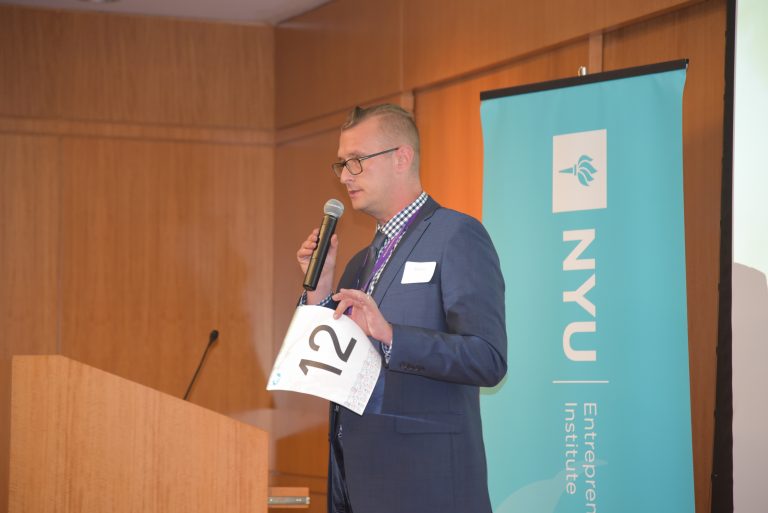
Recently, I was fortunate enough to be included in the 2016 NYU Healthcare Makerthon – an initiative between the NYU Entrepreneurial Institute & the NYU Langone School of Medicine. The goal of the Makerthon is to solve an important, health-related challenge by completing some step-work:
- Identify the challenge,
- recruit a quality team and then,
- together, develop a solution into a viable venture.
My challenge is to “Re-imagine the medical research process to give participants a better experience.”
Does the number “$2.8 billion” sound familiar? If it does, you might work in clinical research. If it doesn’t, that number (and 10-15 years) is what it takes to get a therapy FDA-approved and to the public. PhRMA companies spent almost $60 billion on R&D in 2015. The NIH kicked-in an additional $31 billion.
Anyone who has ever looked at the numbers or attended a study Investigator’s Meeting knows, poor study enrollment and retention account for a huge portion of those costs.
If a potential therapy is able to pass a recruitment feasibility assessment, the costs of enrollment often leads to study discontinuations and therapies that “die on the vine”. Additionally, sponsors may be forced to loosen study eligibility criteria to improve enrollment, only to hand the FDA under-powered data that is too weak to properly evaluate.
Before anyone clicks the back button because they (understandably) have a tough time feeling empathetic over Big Pharma’s recruitment woes, let me assure you I’m not trying to inspire empathy. There is more to the story.
Most of my research background has been limited to clinical trials with pharmacological interventions. But, more recently, I’ve been involved with other types of medical research at NYUMC’s Dept. of Radiology and Center for Biomedical Imaging. We have an amazing team of brilliant scientists, physicists, doctors & engineers (think Matt Damon in Good Will Hunting) – all working to improve patient outcomes through innovative imaging methods. The way I like to explain it to people who don’t regularly write mathematical formulas on window panes, is to try to remember what a television’s picture looked like in the 80’s and compare it with what you see today when you walk into Best Buy. There’s HD, 4K, curved screens, amazing sound, 3-D and VR. The quality of TV sets and peripherals has improved dramatically since Johnny Carson was on weeknights at 11:30 ET.
That’s essentially what our researchers are doing with medical imaging technology like MRI, PET, post-processing software, sequence development & 3-D printing. We move forward by recruiting study participants who graciously volunteer for imaging scan(s).
Some participants have a diagnosis such as Alzheimer’s, cancer, osteoarthritis or Parkinson’s. Others are healthy volunteers whose images are used for comparisons. From what i’ve observed, the participant’s experience is usually good enough for them to refer their friends and family to us.
I use imaging research as an example, hoping to soothe any lingering beliefs that medical research is confined to corporate interests. I admit, it’s easy to become jaded with all the negative press surrounding the pharmaceutical industry. But, to their credit, Hep C (associated with 19,659 deaths in 2014) is now curable in > 90% of patients (within < 12 weeks of treatment).
New pharmaceutical therapies have also contributed to a huge reduction in the amount of cancer, autoimmune and heart disease-related deaths over the last decade. But meanwhile, all over the world, researchers are developing technologies, medicines, prosthetics, implants, procedures, apps, software & naturalistic therapies (just to name a few) aimed at lengthening and improving the quality of human lives. Sure, it’s not all altruistic, but if people are earning a healthy living by developing these therapies, IMHO, it’s as it should be.
It seems to me that finding a solution to research recruitment/engagement challenge could cut R&D costs, resulting in lower healthcare costs and faster delivery of therapies to the patients who need them. But I digress.
After brainstorming potential solutions and getting some ideas on paper, I discovered the WordPress forums and managed to put some of my ideas into a website. I’m not a web guy and while building it, I wasn’t sure what may take shape. But I really enjoyed it as a creative outlet and it was therapeutic for me. TrialSphere also gave me an opportunity to shed some light on an idea that I had found tough to articulate.
Joining NYU Langone School of Medicine has exposed me to more opportunities than I can keep tabs on, including this Makerthon challenge. On 10/26/16, Makerthon participants gave brief overviews of their challenges to an audience of mostly NYU & NYU Langone Medical Center community members. After we said our piece, two Apple, Inc. engineers presented the capabilities of iOS, ResearchKit, CareKit and HealthKit. These open-source development platforms are powerful and the timing is perfect to build them into the research recruitment/engagement space. With the right team, we could leverage these platforms to build a simple, intuitive, powerful and scalable solution for this challenge.
My next step in the Makerthon project is recruiting a team of 3-5 people to join me. Ideally, I need a developer, designer and someone with general business skills. None of these skills are part of my background, but I can sure help navigating the research environment.
The Makerthon’s Phase II takes place November 18-20 (RSVP here.). This phase involves working with top healthcare investors, entrepreneurs and startup experts to help develop the idea into a viable venture. The top 4 teams selected by a panel of healthcare startup experts will receive cash prizes totaling $10,000 and advance to Phase III – “Venture Support” (Jan. 19-Feb. 19).
So, here is my call to YOU for action:
- If you’re a developer, designer, business person, or,
- if you have a desire to crack this challenge and believe you have something to contribute … please don’t hesitate to contact me directly or leave a comment below.
Enjoy the Cubs winning the World Series and Happy Halloween Everyone!
Many Thanks,
Steve Stork